
By midsummer, a healthy indeterminate tomato plant can be carrying 15 to 20 pounds of fruit on stems that started the season as six inch transplants, and without the right support, those stems will crack.
That is why weak tomato cages cause so many problems. They look fine in May. By August, they lean, bend, or fall over. Then fruit touches the soil, leaves stay damp, and disease spreads through the bed.
This matters even more if you grow indeterminate tomatoes. These plants keep growing until frost. Many need a tomato support system that is tall, strong, and easy to manage.
Good support is about more than keeping plants upright. It improves airflow, keeps fruit clean, makes harvesting easier, and helps you use vertical gardening space better.
Below, you will learn which tomato trellis ideas DIY gardeners can build, which one fits your garden size, and how to build the best option before your plants need it.
Why Every Tomato Garden Needs a Trellis, Not Just a Cage.
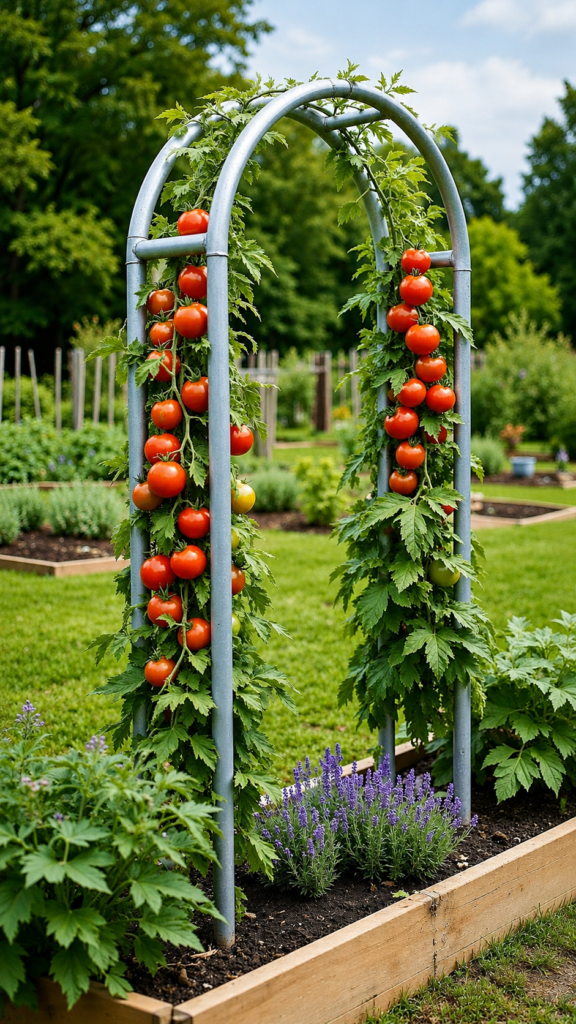
Picture 15 pounds of tomatoes hanging from one plant. Now picture that plant sitting inside a thin wire cage from the garden center.
That is the real problem.
Indeterminate tomatoes can carry 15 to 20 pounds of fruit by midsummer, and mature plants may produce 20 to 30 pounds over a full season. Johnny’s Selected Seeds also notes that an indeterminate tomato plant with five or six fruit clusters can pull 10 to 12 pounds downward on its trellis. That means the support needs to be tall and strong from the start.
A weak cage often fails right when the plant is most valuable.
Beyond the weight problem, there is a disease angle many gardeners miss. When tomato leaves and fruit touch the soil, rain can splash soilborne pathogens onto the lower leaves. Once those leaves are infected, disease can move up the plant.
Penn State Extension says supported tomatoes have better airflow, and that can reduce fungal disease. Johnny’s Seeds also teaches that trellising helps keep fruit off the soil, improves plant health, and makes harvest easier.
That matters for early blight, Botrytis, and other fungal problems that love damp leaves.
Trellising also helps you harvest faster. You can see ripe fruit instead of digging through a tangled plant. You also break fewer stems because the plant has a clear shape.
The support should match the tomato type. Determinate tomatoes grow more like bushes and often stop around 3 to 5 feet. Indeterminate tomatoes keep vining and may need support around 6 to 8 feet tall. Penn State describes a tomato trellis structure as 6 to 8 feet tall.
Interest in home tomatoes is rising too. The RHS reported a 14 percent lift in tomato variety sales in 2025 and expects demand to continue in 2026.
The good news is simple. A few cheap DIY tomato support builds solve most of these problems.
Now let’s look at the best ones.
How to Build a Florida Weave Tomato Trellis.
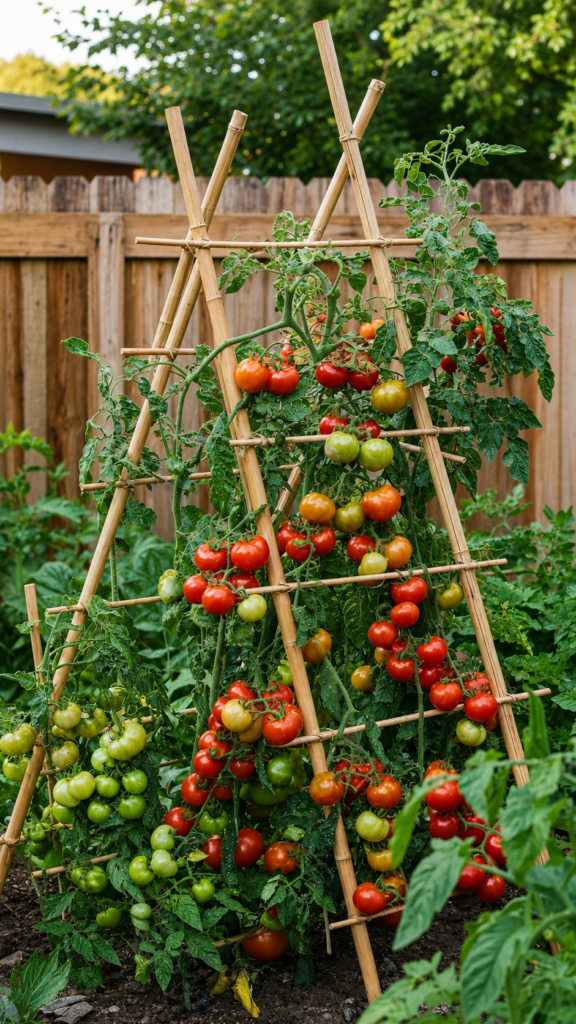
The Florida Weave is the best low cost choice for rows of determinate tomatoes.
It is also one of the fastest methods to build.
A Florida weave tomato trellis uses stakes and twine. You place stakes every 2 or 3 plants. Then you weave garden twine along one side of the plants, around the stake, and back along the other side. As the plants grow, you add more rows of twine.
Johnny’s Seeds calls basket weaving a common way to trellis determinate tomatoes in field growing. It is fast and saves labor. MIGardener also describes the Florida Weave as a simple method that does not need expensive trellises or staking every single plant.
This method works best when your tomatoes grow in a straight row.
What you need:
- Wooden stakes, rebar, or T posts
- Strong garden twine
- A hammer or post driver
- Tomato clips if you want extra support
- Pruners for removing crowded growth
Here is how to build it.
- Plant tomatoes in a straight row.
- Drive a strong stake at each end of the row.
- Add more stakes every 2 or 3 plants.
- Wait until plants are about 12 inches tall.
- Tie twine to the first stake.
- Run the twine along one side of the plants.
- Wrap it around the next stake.
- Come back along the other side of the plants.
- Pull the twine snug, but do not crush stems.
- Add a new row of twine every 6 to 8 inches as plants grow.
For better airflow, prune each plant to 2 or 3 main stems. This keeps the row from becoming a thick wall of leaves.
The big win is cost. Simply Made Homestead says the Florida Weave uses simple materials like wooden stakes and garden twine, and it is a strong, cost effective way to support tomato plants. Their cost comparison also makes the point clear. Cattle panels can cost far more when you are trellising several rows.
Use jute or sisal twine if you want easier cleanup at the end of the season. Plastic twine is strong, but you have to remove it from the bed.
Best for: row gardens, determinate tomatoes, and low budget growers.
Skip it if: you grow tall indeterminate vines above 5 feet. They often need a stronger vertical tomato trellis.
DIY Cattle Panel Tomato Trellis: The Heavy Duty Option.
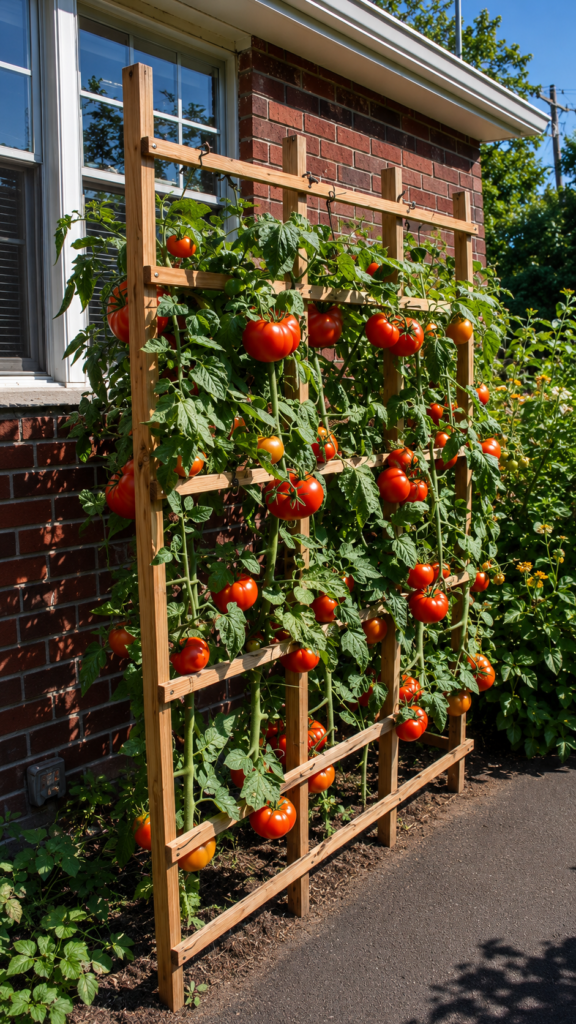
If you grow indeterminate tomatoes, a cattle panel tomato trellis is one of the strongest DIY choices.
This is the support you build when you are tired of replacing weak cages every year.
A cattle panel is a 16 foot galvanized wire panel. You attach it to T posts, wooden posts, or the side of a raised bed. Tomatoes grow along the base, and you guide the vines through the wire grid.
The Rustic Elk reports that one full cattle panel tomato trellis costs about 70 dollars if you buy new materials, including 200 tomato vine clips and wire clips or zip ties. The same source says a 16 foot cattle panel costs around 30 dollars, with the trellis itself around 45 dollars before clips.
That is more money than twine and stakes.
But it lasts much longer.
A cattle panel trellis is best for indeterminate tomatoes, raised beds, and gardeners who want a structure they can reuse for many seasons. Boots and Hooves Homestead also says support is essential for indeterminate varieties because they can grow tall and heavy.
What you need:
- One 16 foot cattle panel
- Two to four T posts
- Wire clips, zip ties, or fencing staples
- Tomato vine clips
- Work gloves
How to build a flat cattle panel trellis:
- Pick a sunny row or raised bed edge.
- Drive one T post at each end.
- Add middle posts if the row is long.
- Stand the cattle panel upright.
- Fasten the panel to the posts with wire clips or zip ties.
- Plant tomatoes along the base.
- Clip or tuck vines into the grid as they grow.
You can also make an arch. Place two raised beds a few feet apart. Bend the cattle panel between them and fasten each side to posts. Then grow tomatoes, cucumbers, beans, or squash up the arch.
Oak Hill Homestead lists cattle panel arches as sturdy, useful, and good for saving space. One gardener even reported a cattle panel arch surviving severe weather in 2023. That is the kind of strength you want when a tomato plant is heavy with fruit.
A 16 foot cattle panel often costs about 25 to 35 dollars, depending on your area and farm supply store. Call before you drive there. These panels can sell out during spring planting season.
Best for: indeterminate tomatoes, raised beds, and long term garden beds.
Overkill for: two container tomatoes on a patio.
How to Build a Vertical String Tomato Trellis.
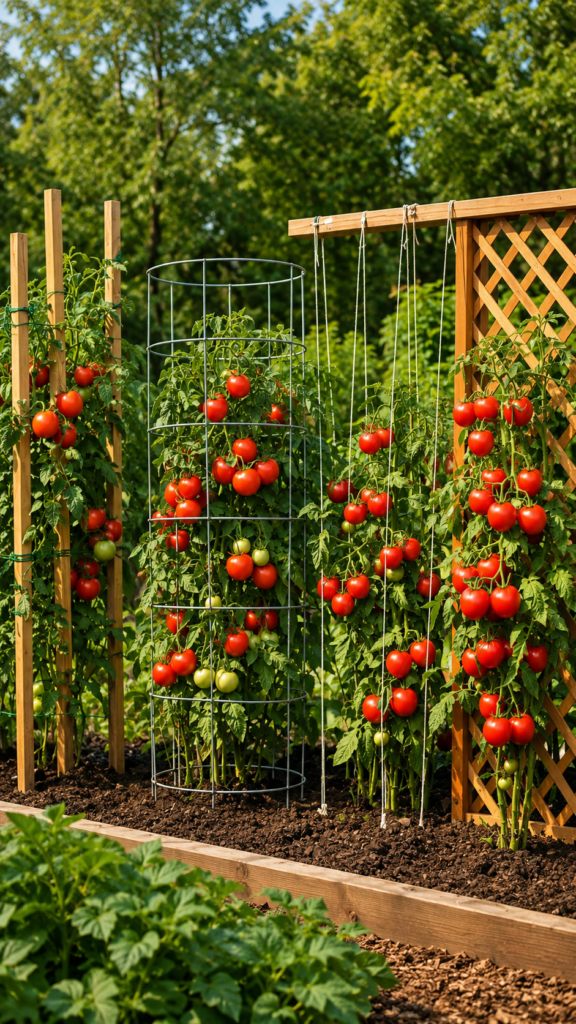
A vertical string tomato trellis is the best choice when you want tall plants in a tight space.
This is the system many greenhouse and high tunnel growers use. You can copy the same idea in a backyard row.
The setup is simple. You place tall posts at the ends of the row. You stretch strong wire across the top. Then you hang one string down to each tomato plant. As the plant grows, you twist the main stem around the string or attach it with tomato clips.
Where cattle panels are fixed and grid based, this string system is flexible. You can change the layout each season.
Johnny’s Seeds says the hanging string system works well for pruned indeterminate tomatoes in the field or in protected growing spaces. It also makes pruning easier because each stem gets its own string. Penn State describes a similar tomato trellis with a strong 6 to 8 foot frame and cords that support each tomato plant.
What you need:
- 8 foot wooden or steel posts
- Strong wire for the top line
- Jute, sisal, or greenhouse twine
- Tomato clips
- A post driver
- Pruners
How to build it:
- Drive tall posts at both ends of your row.
- Add extra posts every 6 to 8 feet if needed.
- Stretch strong wire between the tops of the posts.
- Tie one string above each tomato plant.
- Anchor the bottom of each string near the plant base.
- Train the main stem up the string.
- Clip or twist the plant every few days.
- Remove extra suckers to keep one main stem.
That last step matters.
This system works best when each plant has one main stem. If you let every sucker grow, the plant turns into a wide bush. Then one string cannot hold it well.
The string tomato trellis DIY method is great for high density tomato growing. You can fit more plants in less space because each plant grows up instead of out.
It also makes harvest neat. Fruit hangs where you can see it.
The trade off is time. You need to prune and clip often. It takes one season to get used to it. The second year feels much easier.
Best for: indeterminate tomatoes, greenhouses, high tunnels, and narrow rows.
Skip it if: you do not want to prune tomatoes often.
DIY A Frame Tomato Trellis for Raised Beds.
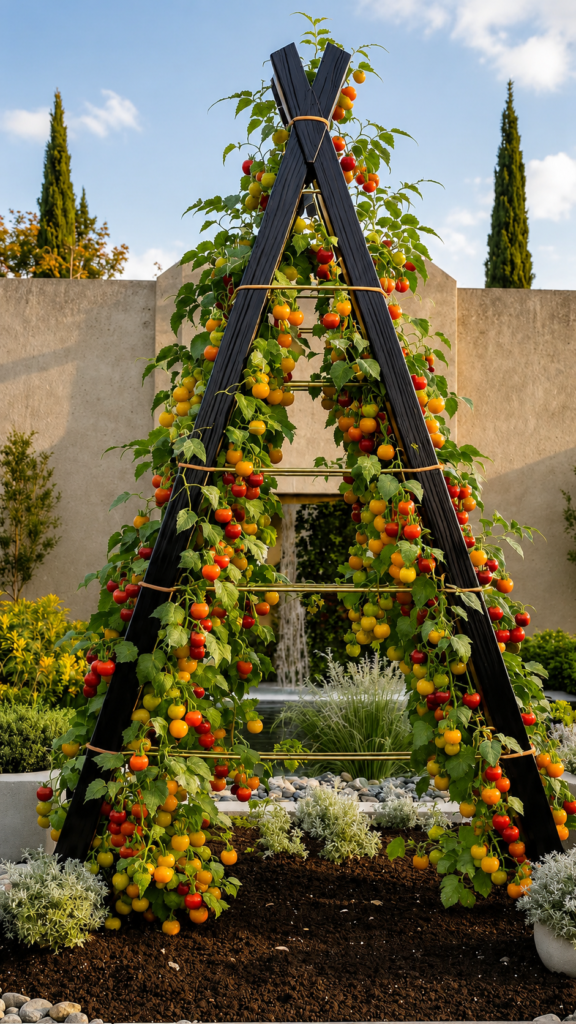
An A Frame tomato trellis gives you support and a garden structure that looks good.
Not every trellis has to look like farm fencing.
An A Frame uses two wooden ladder style frames leaned together. The frame straddles a raised bed or row. Tomatoes grow up both sides. You can add horizontal wood rungs, wire, or twine for more places to clip stems.
This is one of the best tomato trellis ideas DIY gardeners choose when the garden is close to a patio, walkway, or outdoor seating area.
Gardening Know How lists A frame trellises as one of the sturdy DIY options for tomatoes. Epic Gardening also includes many tomato trellis ideas, including simple builds that can be installed quickly.
What you need:
- 1 by 2 or 2 by 4 lumber
- Screws or nails
- Drill
- Saw
- Twine, wire, or thin wood strips
- Tomato clips
How to build it:
- Build two flat ladder frames from lumber.
- Space the rungs 8 to 12 inches apart.
- Lean the two frames together over the bed.
- Screw or tie the top together.
- Add a cross brace if it wobbles.
- Plant tomatoes near each side.
- Clip stems to the rungs as the plants grow.
The biggest mistake is waiting too long.
Build and place the trellis at planting time. Do not try to push a large A Frame over tomatoes that are already full of stems. You will break branches.
A wooden tomato trellis is also easy to change. You can make it taller for indeterminate tomatoes or shorter for determinate types. You can add diagonal poles if you want more climbing surface.
Unlike wire panels, wooden A Frames can come apart and store flat in winter. That helps if you rotate crops and do not want a permanent structure in one bed.
The cost depends on lumber prices. If you use scrap wood, this can be cheap. If you buy new lumber, expect it to cost more than a Florida Weave but less than a large cattle panel setup.
Best for: raised beds, visible gardens, and gardeners who want structure with a clean look.
Skip it if: you want the fastest and cheapest row support.
Which DIY Tomato Trellis Is Right for You?
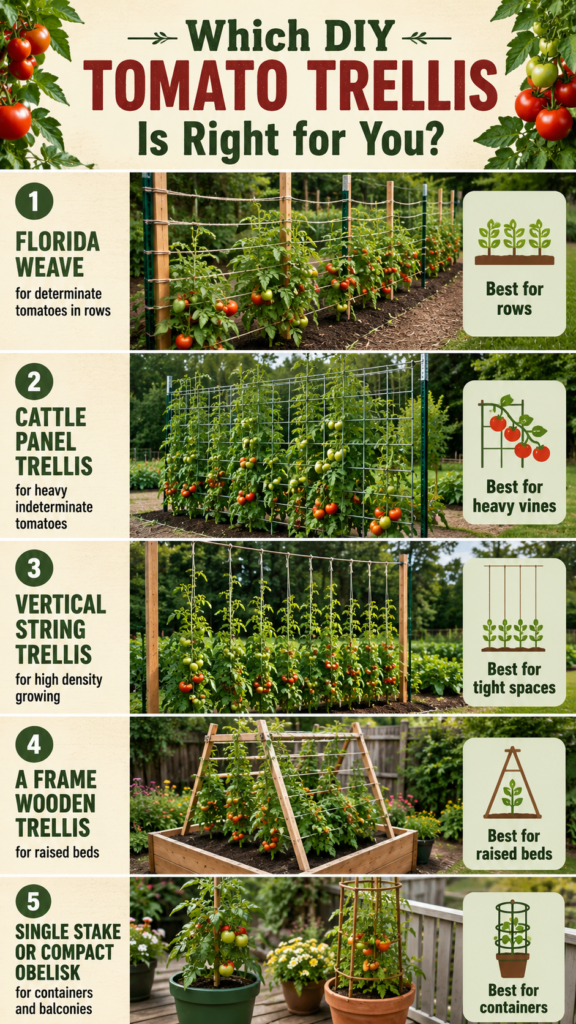
Here is the short version, based on your real garden setup.
Choose the support by plant type first. Then think about space and budget.
Determinate tomatoes usually do fine with a Florida Weave, compact cage, or shorter A Frame. Indeterminate tomatoes need stronger support. They keep growing and can need a 6 to 8 foot structure.
| Trellis Type | Best For | Approx. Cost |
|---|---|---|
| Florida Weave | Determinate tomatoes in rows | Lowest cost, mainly stakes and twine |
| Cattle Panel Trellis | Indeterminate tomatoes and raised beds | About 30 dollars for one panel, about 70 dollars for one full setup with clips |
| Vertical String Trellis | High density indeterminate growing | Low to medium cost, posts plus wire and twine |
| A Frame Wooden Trellis | Raised beds and pretty garden layouts | Medium cost, depends on lumber |
| Single Stake or Compact Obelisk | Containers and balconies | Low to medium cost |
For a small garden with 1 to 4 plants, keep it simple. Use a strong single stake, a compact obelisk, or a tall cage.
For a medium row with 6 to 12 plants, use the Florida Weave or an A Frame.
For a large garden, use cattle panels or vertical string trellises.
For containers and balconies, do not overbuild. A single stake with tomato clips is often enough for compact tomatoes. For indeterminate patio tomatoes, choose the tallest support your pot can safely hold.
Budget matters too. The cheapest choice is the Florida Weave. The best long term choice is cattle panel. The best neat looking choice for raised beds is the A Frame.
Pick one, gather the materials before transplanting day, and build it first.
Conclusion !
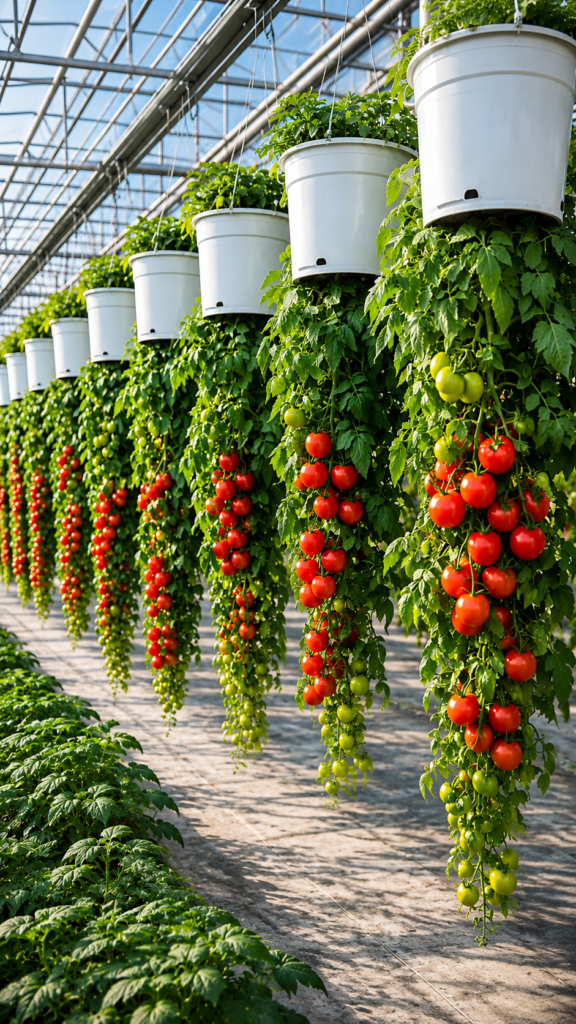
Tomato plants need real support, especially indeterminate tomatoes carrying 20 pounds or more of fruit. Weak cages often fail at the worst time. A good tomato trellis keeps stems upright, improves airflow, keeps fruit off the soil, and makes harvest easier.
The right choice depends on your garden. Use the Florida Weave for rows of determinate tomatoes. Use cattle panels or vertical string trellises for indeterminate vines. Use an A Frame tomato trellis when you want a raised bed support that also looks good.
Pick one method that fits your setup. Gather the materials before your transplants go in the ground. Build it first, before your plants need it.
Whatever tomato trellis idea you choose to DIY this season, the goal is the same: keep your plants upright, your fruit off the ground, and your harvest coming in strong all season long.